
November 2026
Garden Designer and Project Manager, GardenGirls, LLC

Denise Ashley, garden designer and project manager, GardenGirls, LLC. Photo: Craig Goodwin
This quarter Denise shares her story—from a single red tulip to a career in corporate program and project management, and ultimately to building her own landscape design business.
When did you start designing gardens? Tell us about your path from then to now.
My connection to gardens started with one red tulip. Before I was placed in foster care, I grew up in a home where neither the house nor yard was cared for. But beside the pump house, a single red tulip came up every spring. In an environment that often felt chaotic, that tulip was something beautiful and dependable. I didn't know then that gardens would become my career, but I've never forgotten it.
My path to garden design was anything but direct. I earned a bachelor's degree in psychology from Seattle Pacific University, then worked at Boeing and Microsoft in both program and project management, including global projects. That experience taught me to manage complexity, coordinate people with different expertise, solve problems, and keep large projects moving—all skills I use constantly today. While at Microsoft, my interest in gardens continued to grow. I purchased the GardenGirls domain in 2008, left Microsoft in 2009, and studied garden design through the Oxford College of Garden Design.
From there, I built GardenGirls one project at a time. Today, I design and project-manage substantial residential landscapes, working with contractors, architects, engineers, specialty trades, and homeowners from concept through installation.
Looking back, it seems like an unlikely path from that single red tulip to the work I do today. But that early understanding of how much a landscape can affect the way a place feels has stayed with me.
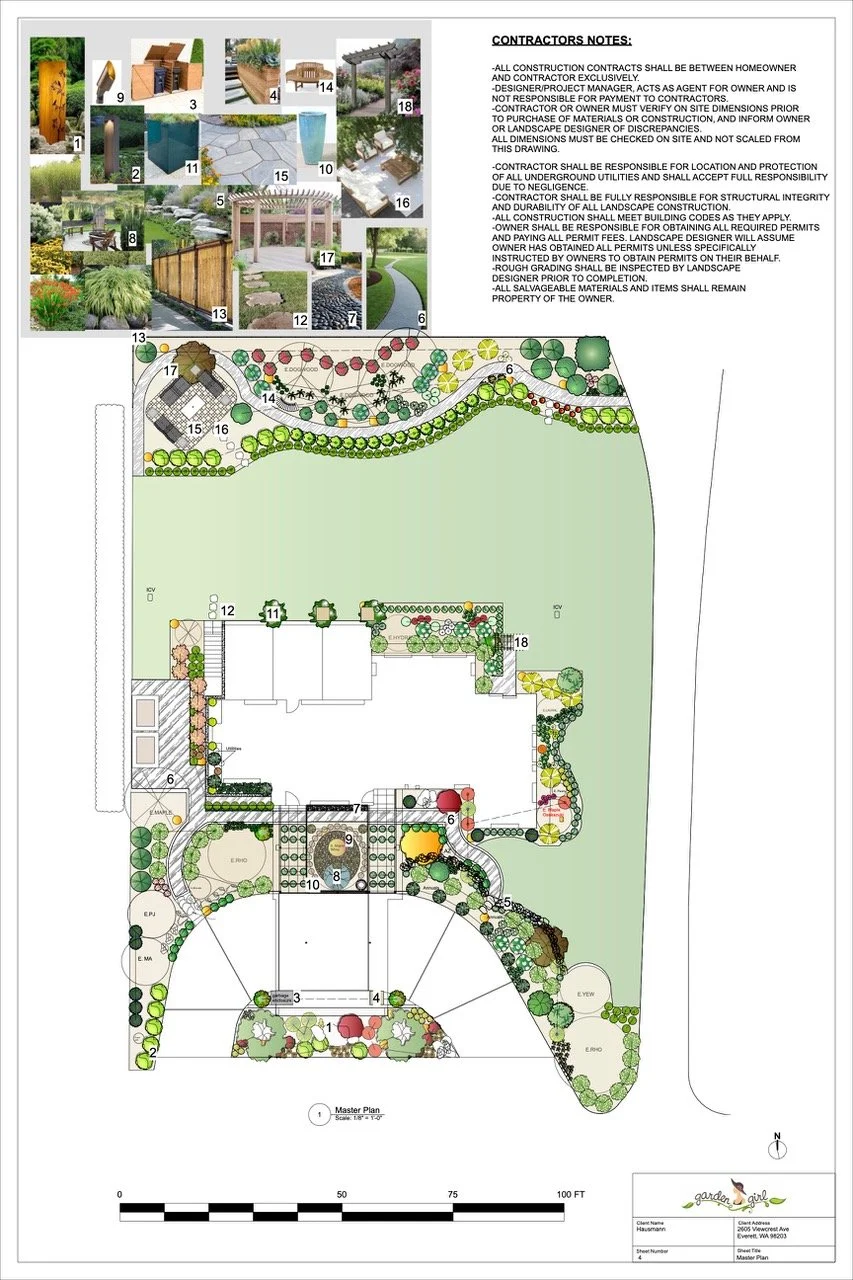
Mukilteo residential master plan—concept imagery and a detailed plan. Image: GardenGirls, LLC
Describe a typical design project and your process.
My typical projects are larger residential and country gardens, and my process begins with understanding both the clients and the site. After the site visit and acceptance of my commission, I send a client brief summarizing the project so we can confirm that I've accurately captured the desired features, parcel and house information, as well as hobbies, favorite colors, and other details that will shape the design.
I then complete a site survey and site analysis with photographs, documentation of existing conditions, and soil pH readings. From there, I develop the concept plan and mood board. Once we establish the overall direction, I refine the design into the master plan with updated mood boards to help clients visualize the finished garden.
The master plan becomes detailed construction documents: hardscape and lighting plans, drainage plans, and technical drawings and specifications for contractors and specialty trades.
The planting plan comes last. For every plant specified, clients receive a plant and maintenance schedule with photographs, botanical names, and care and pruning information, so they understand how the garden will develop over time.
What would your ideal project and client be?
My ideal projects are larger country properties where there is room to create something unexpected. I love memorable features—labyrinths, custom water features, dry streambeds that solve drainage problems, and outdoor spaces for gathering, entertaining, or simply being alone.
My ideal client wants a designer rather than an order taker. Clients bring me a feature list, but I want to understand much more: their hobbies, favorite colors, how they entertain, how they spend time outside, and what they don't like.
I look inside their homes for clues—a painting, fabric, or another piece that reveals what they are drawn to. That requires trust and creative freedom, but it is also collaborative. I try to put myself thoroughly in my clients' shoes so that during construction I can advocate for them even when they aren't beside me.
The best projects happen when clients trust me to push beyond what they initially imagined, while remaining grounded in who they are and how they want to live in their garden.
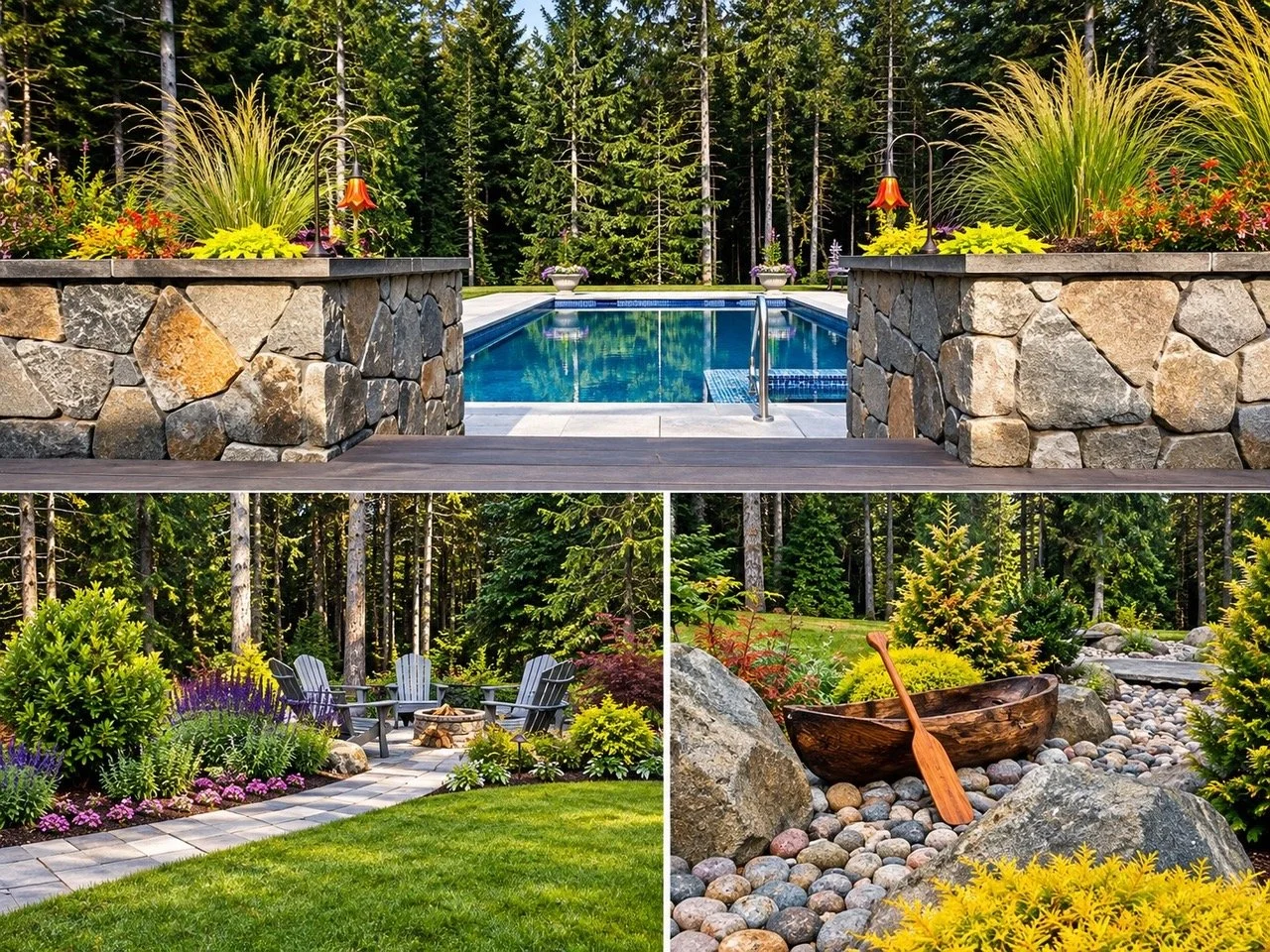
Lake Goodwin—swimming pool, stone walls, fire-pit garden, and carved cedar canoe dry streambed within a five-acre residential landscape. Photo: GardenGirls, LLC
Tell us about one of your favorite or most memorable projects.
My favorite project is probably a five-acre property at Lake Goodwin, but what makes it my favorite has as much to do with the clients as the garden itself.
I had designed the landscape at John and Michael's previous home in Snohomish, so when they purchased a new property specifically because they wanted room for a pool, they brought me with them. Before they had even moved in, they gave me a key to the empty house and I essentially moved in myself. I was measuring the property before the ink was dry on their purchase. At one point, the developer came racing up the driveway demanding to know what I was doing there. Once he discovered I was already working for the new owners, everything was fine.
It was truly tabula rasa. We even relocated a brand-new septic system because it interfered with the best orientation for the pool. Over several years, I designed and helped oversee the transformation of the five acres, coordinating everything from the pool and landscape construction to electricians, plumbers, propane, custom structures, an ADU, and permitting.
But the most meaningful part was the relationship that developed along the way. I became close not only with John and Michael, but with their extended family. Their cousin Sue was living with cancer, and as I got to know her, we became friends. Near the end of her life, I took her to Orcas Island for one last day surrounded by the beauty of the Northwest. Later, I created a memorial garden for her at Lake Goodwin. We have since created an addional memorial garden at the property for another beloved family member.
John and Michael trusted me enormously, both creatively and personally. That trust allowed the garden to evolve over years rather than simply being installed as a collection of features. Lake Goodwin reminds me that the best projects aren't ultimately about pools, patios, or plants. They're about the people who will live their lives within them.
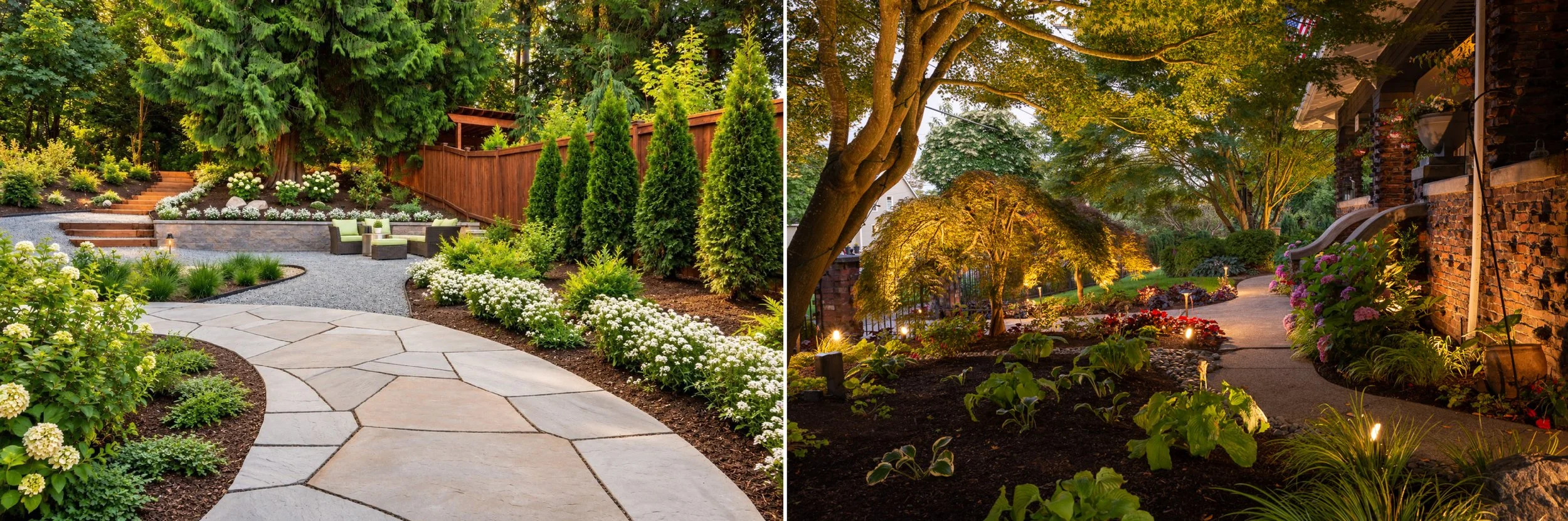
Snohomish residential garden. From left: Curving flagstone path leads to the gravel gathering area with terraced steps, and layered planting beneath mature evergreens. Low-voltage lighting guides movement through layered planting while highlighting mature Japanese maples and the home's architecture. Photos: Jared Burns
How have permitting requirements (stormwater, ECA, etc.) or site limitations affected your design process and creativity?
One of my most challenging permitting experiences began with something surprisingly small. During a large residential project on Maple Avenue in the City of Snohomish, we were repairing an existing two-foot retaining wall next to the sidewalk. The City saw the work and required us to have the wall engineered. That single requirement ultimately cascaded into multiple permits involving grading, drainage, utility easements, engineered details, bonding, and inspections.
What had begun as one element of a much larger garden became a significant part of the project. I worked closely with our architect/engineer, general contractor, clients, and the City as we moved through revisions, resubmittals, and changing requirements. By final inspection, we had worked through 18 correction items, with inspectors sometimes giving us different directions. This experience reinforced the importance of documenting decisions carefully and bringing in architects or engineers as needed.
At the same time, I don't want those constraints to become the design. My role is still to create a beautiful, cohesive garden while solving the technical problems behind it. Maple Avenue taught me just how quickly a seemingly minor site condition can affect an entire project—and how important it is for a designer to be able to navigate both the creative and technical sides of the work.
Denise Ashley
GardenGirls, LLC
https://www.gardengirl.com
info@gardengirl.com